
You open the pantry to grab the cereal, and there they are—a winding trail of tiny ants marching across your countertop like they own the place. If you’re trying to figure out how to get rid of ants in your kitchen, you’re far from alone. Ants are the single most common household pest in the United States, and kitchens are their number one target.
The frustrating part? Most people try a quick fix—a spray here, a wipe-down there—only to find the ants back within days. That’s because getting rid of kitchen ants for good requires understanding why they showed up in the first place, what species you’re actually dealing with, and how to address the root cause rather than just the visible symptom.
We’re Green Haven Pest Control, and we help homeowners across Crawfordsville and Montgomery County, Indiana deal with exactly this problem every single week. In this guide, we’ll walk you through everything you need to know to get rid of ants in your kitchen the right way—from identifying the species in your home, to practical prevention steps, to knowing when it’s time to call in a professional.
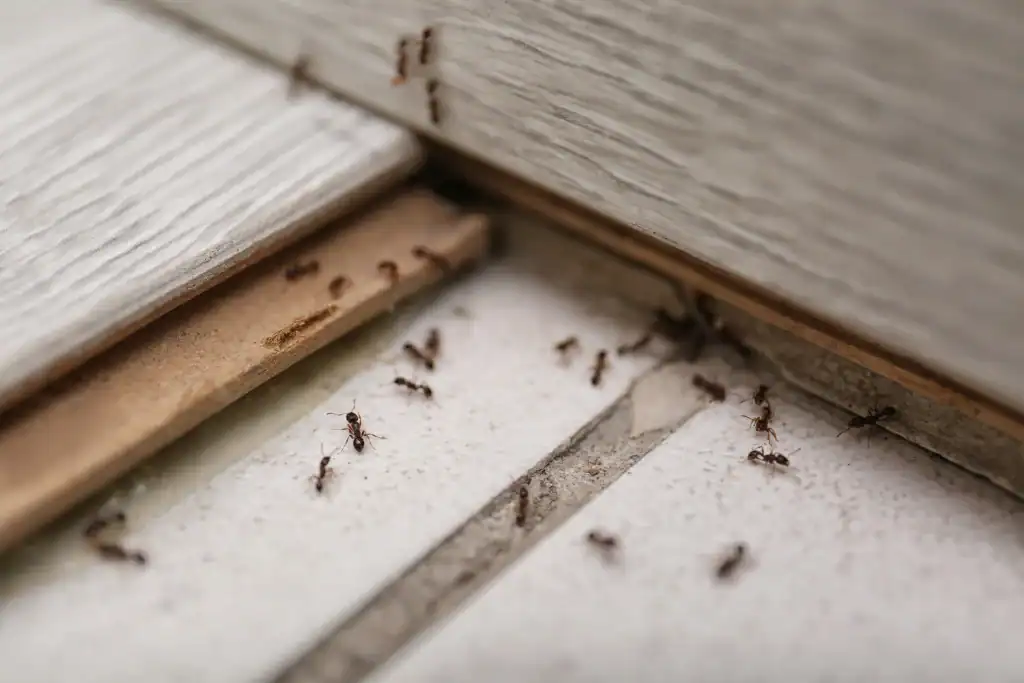
Why Ants Target Your Kitchen
Before you can solve a problem, you need to understand it. Ants don’t invade kitchens randomly. They’re driven by three basic survival needs: food, water, and shelter. Your kitchen happens to offer all three in abundance.
Every ant colony sends out scout ants whose sole job is to locate food sources. When a scout finds something promising—a sticky spot on the counter, a crumb under the toaster, a drip of honey on the pantry shelf—it lays down a chemical trail called a pheromone path. That invisible trail is essentially a GPS signal for the rest of the colony, telling hundreds or even thousands of workers exactly where to go. This is why you can wipe down the counter and still see ants following the same path an hour later. The pheromone trail persists until it’s physically cleaned away. (For more on ant foraging behavior and trail pheromones, see Purdue University’s Ant Behavioral Ecology Lab.)
Moisture is the other major draw. Leaky faucets, damp sponges, pet water bowls, and condensation around dishwashers all create the kind of reliable water source ants need to sustain a colony. In the warmer months here in central Indiana—typically from late March through October—ant activity ramps up significantly as colonies expand and forage more aggressively. According to Purdue Extension entomologists, ants are typically found foraging in kitchens and other areas where open water and food sources are available, though their nests may be located some distance away.
Identify the Ant Species in Your Kitchen
This step matters more than most people realize. The species of ant in your kitchen determines how serious the problem is, where they’re nesting, and what treatment approach will actually work. Here in Montgomery County, two species account for the vast majority of kitchen ant calls we respond to: odorous house ants and carpenter ants.
Odorous House Ants
Odorous house ants are the most common kitchen invader in Indiana. They’re small—about 1/16 to 1/8 of an inch long—dark brown to black, and they move in well-defined trailing lines. The easiest way to identify them is to crush one and smell it. Odorous house ants release a distinctive smell often described as rotten coconut. It’s unmistakable once you know what you’re looking for.
These ants are primarily a nuisance pest. They’re after sugary and greasy foods, and a single colony can contain tens of thousands of workers with multiple queens. That multi-queen structure is one reason they’re so persistent. If you spray and kill a portion of the colony, the surviving queens simply relocate and rebuild. This process, called budding, actually makes the problem worse—you go from one colony to several. Research from Dr. Grzesiek Buczkowski’s lab at Purdue University has documented how the spatial distribution of odorous house ant colonies and their polydomous (multi-nest) structure makes conventional spray treatments particularly ineffective and can cause colonies to fragment and spread.
Odorous house ants typically nest outdoors in soil, under rocks, or beneath mulch. They enter through tiny cracks in your foundation, gaps around windows and doors, and utility line penetrations. During heavy rain or extreme heat, they often move their nesting sites indoors, which is when homeowners notice a sudden surge in activity.
Carpenter Ants
Carpenter ants are a different animal entirely—literally and in terms of risk. These are large ants, typically 1/4 to 1/2 inch long, usually black or dark reddish-brown. When you see a big ant walking across your kitchen floor, especially at night, there’s a good chance it’s a carpenter ant.
Unlike odorous house ants, carpenter ants can cause real structural damage to your home. They excavate wood to build their nesting galleries, and over time, that damage can compromise wall studs, floor joists, and window frames. Carpenter ants don’t eat wood the way termites do—they simply remove it—leaving behind smooth, sandpaper-clean tunnels and small piles of wood shavings called frass. As Purdue Extension notes, carpenter ant nests are usually found in wood with a higher-than-normal moisture condition, and their trademark is a small pile of coarse sawdust beneath their nesting site.
If you’re seeing large ants in your kitchen, especially during the evening hours, it’s worth taking seriously. The workers you see foraging are just a fraction of the colony, which could be nesting inside a wall void, in a water-damaged area behind the dishwasher, or in a moisture-compromised section of your subfloor. Carpenter ants are drawn to wood that has been softened by moisture, so a kitchen with any kind of plumbing leak is prime real estate for them.

How to Get Rid of Ants in Your Kitchen: Step-by-Step
If you’re dealing with a small number of ants—a handful of scouts or a short trailing line—there are several practical steps you can take on your own before calling a professional. These steps work best for odorous house ants and other small nuisance species. If you suspect carpenter ants, skip ahead to the section on when to call a professional.
Step 1: Eliminate the Pheromone Trail
Your first move is to destroy the chemical highway the ants are following. Mix a solution of equal parts white vinegar and water in a spray bottle and thoroughly wipe down every surface where you’ve seen ant activity. Pay special attention to countertops, cabinet edges, the backsplash area, and the floor along baseboards. The vinegar disrupts the pheromone signal and makes it harder for foraging ants to navigate back to the food source.
A word of caution: avoid the temptation to use an over-the-counter ant spray at this point. Contact-kill sprays eliminate the ants you can see while doing nothing to the colony itself. Worse, with odorous house ants, spraying can trigger that budding response we mentioned earlier, causing the colony to fracture and spread.
Step 2: Remove All Food Sources
Ants are resourceful. They can sustain a foraging trail on remarkably small amounts of food. Go through your kitchen with a critical eye and address every potential attraction.
- Store all dry goods—cereal, sugar, flour, pet food, snacks—in sealed glass or hard plastic containers. Cardboard boxes and twist-tied bags are no barrier to ants.
- Clean behind and underneath appliances. The gap under the toaster, the crumb tray in the oven, and the space beneath the refrigerator are common hotspots.
- Wipe down all surfaces after every meal, including the stovetop, countertops, and dining table.
- Take out the trash every evening, especially if the bag contains food scraps. Use a trash can with a tight-fitting lid.
- Don’t leave dirty dishes in the sink overnight. Even a plate with a thin film of pasta sauce is a feast for an ant colony.
- Clean up pet food bowls after feeding time. Standing pet food is one of the most overlooked ant attractants in kitchens.
Step 3: Eliminate Moisture
Fix any leaky faucets, pipes, or supply lines under the kitchen sink. Dry out sponges and dish rags rather than leaving them sitting in pooled water. If you have condensation forming on cold water pipes, consider insulating them. Small steps to reduce moisture can have an outsized impact on ant activity, particularly for carpenter ants that depend on damp wood for nesting.
Step 4: Seal Entry Points
Walk the perimeter of your kitchen and look for gaps ants could use to get inside. Common entry points include cracks in the foundation visible from inside cabinets, gaps around plumbing penetrations under the sink, poorly sealed window frames, and spaces where utility lines enter the wall. Seal small gaps with silicone caulk. For larger openings around pipes, use copper mesh stuffed into the gap and sealed with expanding foam. Purdue Extension recommends sealing cracks and openings on the exterior of buildings and keeping overhanging branches trimmed away from the roofline as key preventive measures.
Step 5: Use Bait Stations Strategically
If ants keep returning after you’ve cleaned up and sealed entry points, targeted bait stations are the most effective next step. Ant baits work by exploiting the colony’s own food-sharing behavior. Worker ants carry the bait back to the nest and distribute it to other workers, larvae, and—critically—the queen. Once the queen is eliminated, the colony collapses.
Place bait stations directly along the trailing paths you’ve observed, near entry points, and in protected areas like the back of cabinets or under the sink. Resist the urge to kill the ants around the bait. You want them to feed and return to the nest. It typically takes several days to a couple of weeks for baits to fully eliminate a colony, so patience is essential.
Choose a sugar-based bait for odorous house ants, as they have a strong preference for sweet substances. Protein or grease-based baits tend to be less effective for this species.
Long-Term Prevention: Keeping Ants Out of Your Kitchen for Good
Getting rid of ants is only half the equation. Keeping them from coming back is what turns a temporary fix into a lasting solution. Here are the prevention habits we recommend to every homeowner we work with.
Exterior Maintenance
- Trim tree branches, shrubs, and vegetation so they don’t touch or overhang the house. Ants use these as bridges to reach upper-level entry points.
- Pull mulch back at least 12 inches from the foundation. Mulch retains moisture and provides ideal nesting habitat for many ant species.
- Store firewood at least 20 feet from the house and elevated off the ground. Firewood is a common nesting site for carpenter ants.
- Keep gutters clean and ensure downspouts direct water away from the foundation. Pooling water near the structure attracts moisture-loving pests.
Interior Habits
- Maintain a daily wipe-down routine for all kitchen surfaces.
- Run the garbage disposal regularly and keep the drain clean. Organic buildup in drains can attract ants.
- Inspect grocery bags and produce before bringing them inside. Ants occasionally hitch rides into your home on packaging.
- Schedule a seasonal deep clean of your kitchen, pulling out appliances to clean behind and underneath them.
Prevention works best when it’s consistent. Ants are persistent foragers, and a single lapse—a sugary spill left overnight, a trash bag that sits too long—can restart the cycle.
When to Call a Professional to Get Rid of Ants in Your Kitchen
DIY methods work well for minor ant activity, especially when you catch the problem early. There are situations, though, where professional intervention is the smarter path.
You should consider calling a pest control professional if the ants keep coming back after multiple rounds of cleaning, sealing, and baiting. Recurring activity usually indicates a colony that’s nesting inside the structure—in a wall void, under the slab, or in a crawl space—where consumer-grade products simply can’t reach.
If you’re seeing large ants (1/4 inch or bigger), especially at night, you likely have carpenter ants. Given their potential for structural damage, carpenter ant problems are not something to experiment with. A professional inspection can locate the nest, assess any existing damage, and apply targeted treatment to eliminate the colony at its source.
You should also call for help if you’re finding ants in multiple rooms, if the trailing lines are thick and persistent, or if you’ve noticed small piles of fine wood shavings (frass) near baseboards or window frames. These signs all point to a more established problem that needs professional-grade solutions.
How Green Haven Pest Control Handles Kitchen Ant Problems
At Green Haven Pest Control, we take a different approach than what you might expect from a pest control company. We don’t walk in, spray everything, and hand you a bill. We start with a thorough inspection to identify the species, locate the nest or nesting area, and understand the conditions that are allowing ants to thrive in your home.
Our approach is rooted in Integrated Pest Management, or IPM. That means we target the specific problem with the most effective, least invasive methods available. As the U.S. Environmental Protection Agency explains, IPM is an environmentally sensitive approach that uses current, comprehensive information on pest life cycles and their interaction with the environment to manage pest damage with the least possible hazard to people, property, and the environment. For odorous house ants, that often means a combination of exterior perimeter treatment, targeted baiting along trailing routes, and sealing the entry points they’re exploiting. For carpenter ants, we go further—using moisture meters and thermal imaging when needed to pinpoint nesting sites inside walls, then applying targeted treatment directly to the colony.
We believe in solving the problem at its root rather than masking symptoms. Every treatment plan we build includes specific recommendations for the conditions in your home that attracted ants in the first place, from plumbing leaks to landscaping adjustments. Our goal is to make your home less hospitable to ants so the problem doesn’t circle back around next season.
For homeowners who want ongoing protection, our Guardian Program provides scheduled preventive treatments throughout the year, covering ants along with the other common pests we see here in Montgomery County. Members get priority scheduling, guaranteed re-treatments between visits if any covered pest returns, and the peace of mind that comes from knowing someone is proactively managing your home’s defenses.
Frequently Asked Questions About Kitchen Ants
Why do I suddenly have ants in my kitchen?
Sudden ant activity is almost always triggered by a change in conditions: a new food source the ants discovered, a moisture event like a plumbing leak, or a weather shift. Heavy rain and extreme heat are the two biggest drivers of indoor ant surges here in central Indiana. Both conditions push colonies to seek shelter and resources inside your home.
Are ants in the kitchen dangerous?
Most kitchen ants, including odorous house ants, are nuisance pests. They contaminate food and are unpleasant to deal with, but they don’t bite or sting in any meaningful way. Carpenter ants are the exception—while they won’t harm you directly, they can cause significant structural damage to your home over time if left unchecked.
Why do ants come back after I clean?
There are a few common reasons. Pheromone trails can persist even after a surface wipe if the cleaning product doesn’t break down the chemical compound—vinegar-based solutions are more effective for this than plain water. The colony may also have a nest inside your home’s structure, which means the source of the problem is beyond what surface cleaning can address. If cleaning alone isn’t working after a week or two, it’s a sign the colony needs to be treated directly.
Do home remedies like cinnamon or peppermint oil work?
Some natural substances can act as short-term deterrents by disrupting scent trails or making an area less appealing to scouts. The problem is that they don’t address the colony itself. Ants are adaptable—they’ll simply find an alternate route. Think of it like putting a roadblock on one street. The traffic just reroutes. For a lasting solution, you need to eliminate the colony, and that requires baiting or professional treatment.
How long does it take to get rid of ants in the kitchen?
With proper baiting and sanitation, a minor odorous house ant problem can be resolved in one to three weeks. Carpenter ant issues typically take longer because locating and accessing the nest is more involved. Professional treatments generally produce faster results because the products and techniques used are more targeted and effective than what’s available to consumers.
Ready to Get Rid of Ants in Your Kitchen for Good?
If ants have turned your kitchen into their personal buffet, we’re here to help. Green Haven Pest Control serves Crawfordsville, Montgomery County, and the surrounding communities in central Indiana. We’ll identify the species, find the source, and build a treatment plan that solves the problem—not just for today, but for the long haul.
Give us a call at (765) 736-2461 to schedule your free inspection. Let’s take your kitchen back.
Your Home, Your Haven.
Sources
- Bennett, G.W. and Gibb, T.J. “Ants” (E-22). Purdue Extension Entomology. extension.entm.purdue.edu/publications/E-22/E-22.html
- Buczkowski, G. Ant Behavioral Ecology and Genetics Lab. Purdue University, Department of Entomology. entm.purdue.edu/ants/ind_research.php
- U.S. Environmental Protection Agency. “Integrated Pest Management (IPM) Principles.” EPA.gov. epa.gov/safepestcontrol/integrated-pest-management-ipm-principles
- Buczkowski, G. and Bennett, G.W. “Colony budding and its effects on food allocation in the highly polygynous ant, Monomorium pharaonis.” Ethology, 115: 1091-1099. entm.purdue.edu/ants/publications.php